Acceleration Testing: Why Transient Dyno Data Matters
July 27, 2026
Understanding Real-World Engine Behavior Beyond Steady-State Testing
In dynamometer testing, steady-state data has long been the foundation for engine development, calibration, and performance validation. Holding an engine at a fixed speed and load provides highly stable measurements for torque, horsepower, fuel flow, temperatures, and emissions.
But engines do not operate in steady-state conditions for very long in the real world.
Whether on a racetrack, accelerating through gears, towing under changing loads, or responding to throttle inputs in daily driving, engines spend much of their operating life in transient conditions where speed and load are constantly changing.
That is where acceleration testing becomes valuable.
Acceleration testing allows engineers and tuners to evaluate how an engine behaves dynamically as rpm changes continuously under controlled load conditions. Rather than collecting isolated operating points, acceleration tests capture the engine’s response throughout the entire acceleration event.
For performance applications, transient tuning, and real-world simulation, acceleration testing provides insights that steady-state testing alone cannot deliver.
What Makes Acceleration Testing Different?
Unlike step testing or steady-state testing, acceleration testing does not pause to stabilize at predefined rpm points. Instead, the dynamometer continuously controls engine loading while allowing the engine to ramp through a specified speed range at a controlled acceleration rate.
The test may be configured using:
- Starting rpm
- Ending rpm
- Ramp rate
- Load control strategy
- Throttle position
- Data acquisition rate
As the engine accelerates, the dynamometer records performance data continuously across the entire rpm sweep.
This creates a detailed picture of transient engine behavior, including:
- Torque delivery
- Air/fuel ratio transitions
- Ignition timing response
- Boost behavior
- Fuel flow characteristics
- Thermal response
- Exhaust behavior
Because these conditions closely resemble actual vehicle operation, acceleration testing is often considered one of the most realistic forms of dynamometer testing for performance development.
Why Ramp Rate Matters
One of the most important variables in acceleration testing is ramp rate, the rate at which engine speed changes during the test. Ramp rate directly affects engine loading characteristics and can significantly influence the resulting data.
A slower ramp rate places the engine under load for a longer period of time, allowing temperatures, airflow, and fueling conditions to stabilize differently than during a rapid acceleration event.
A faster ramp rate reduces test duration and may more closely simulate aggressive vehicle acceleration, but it also changes how inertia affects measured torque.
For this reason, selecting the correct acceleration rate is critical. In many cases, the best acceleration rate is the one that most closely matches the actual operating conditions of the vehicle or application being tested.
Examples include:
- Fast ramp rates for drag racing applications
- Moderate ramp rates for road course or street performance testing
- Slower ramp rates for industrial or heavy-duty engines
Matching the dyno test to the intended operating environment helps improve tuning relevance and data accuracy.
Acceleration rate directly influences measured torque output due to rotational inertia effects
within the engine and dynamometer system.
Understanding Inertia During Acceleration Tests
Acceleration testing introduces a factor that does not significantly affect steady-state testing: rotational inertia. As the engine accelerates, some of its torque output is used to accelerate rotating mass within the engine and dynamometer system itself. This means the dyno is not measuring only engine output — it is also measuring the energy required to increase rotational speed.
The result is simple:
- Measured torque decreases during acceleration
- Measured torque increases during deceleration
The faster the acceleration rate, the greater the inertia effect becomes.
For example, a typical V8 engine may lose several pound-feet of measured torque for every additional 100 rpm/second of acceleration rate.
This is why two acceleration tests performed at different ramp rates may produce noticeably different torque curves, even when testing the exact same engine.
Without understanding inertia effects, it can be easy to misinterpret performance changes that are actually caused by differing acceleration conditions.
Why Repeatability Is Critical
Acceleration testing only becomes valuable when tests can be repeated consistently.
If ramp rates vary between pulls, comparison data becomes difficult to trust. Even small differences in acceleration rate can alter measured torque and horsepower values.
For meaningful comparison testing, the following variables should remain consistent:
- Ramp rate
- Starting and ending rpm
- Throttle conditions
- Data acquisition settings
- Environmental conditions
Modern dynamometer control systems help maintain highly repeatable acceleration rates throughout the test sequence, reducing variability and improving confidence in the data.
This repeatability is especially important when:
- Comparing engine modifications
- Validating calibration changes
- Testing ignition adjustments
- Evaluating intake or exhaust changes
- Conducting back-to-back performance testing
High-Speed Data Collection in Transient Testing
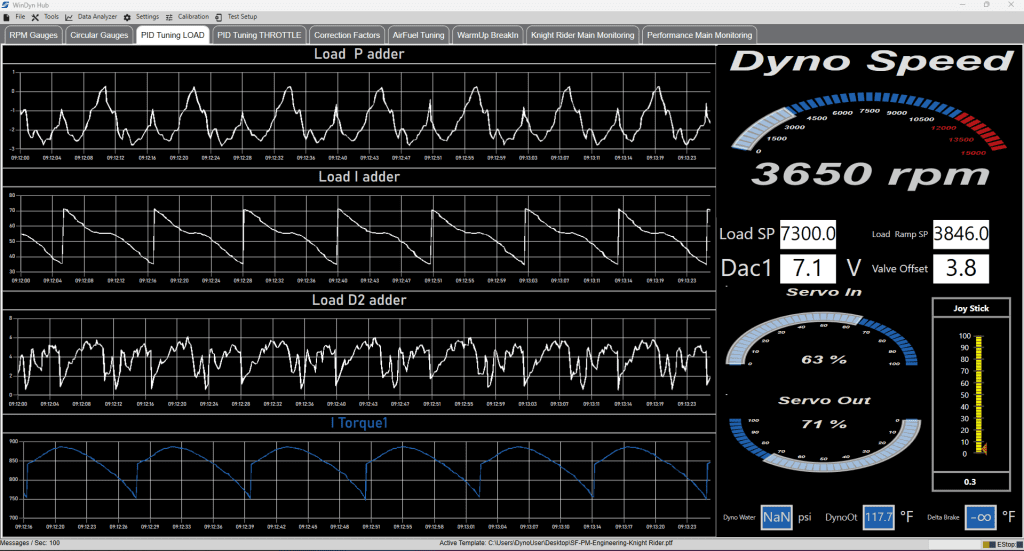
One of the biggest advantages of modern acceleration testing is the ability to capture high-speed transient data. During a rapid acceleration event, engine conditions can change dramatically in fractions of a second. Fuel delivery, boost response, airflow, and ignition timing may all fluctuate rapidly throughout the pull.
Modern dynamometer systems can record data at rates of 100 samples per second or more, allowing engineers to analyze these transient behaviors in detail.
This is particularly valuable when tuning:
- Turbocharged engines
- Fuel injection systems
- Ignition timing curves
- Electronic throttle control
- Traction and torque management systems
Without sufficient data acquisition speed, many transient events may be missed entirely.
Image: Performance Main Screenshot (Caption: Modern dynamometer software can capture transient engine data at extremely high sampling rates during acceleration events.)

Modern dynamometer software can capture transient engine data at extremely
high sampling rates during acceleration events.
Constant Rate vs. Natural Acceleration Testing
Not all acceleration tests behave the same way.
Some tests use closed-loop control to maintain a constant acceleration rate throughout the entire pull. These tests are highly repeatable and are commonly used for calibration work and comparison testing. Other tests allow the engine to accelerate more naturally while the dynamometer controls absorber valve position or load progression.
In these tests, acceleration rate changes according to the engine’s torque curve and power output. Each method has advantages depending on the application.
Constant Rate Testing
Best suited for:
- Repeatable tuning work
- Air/fuel calibration
- Baseline comparison testing
- Controlled transient analysis
Natural or Valve Ramp Testing
Best suited for:
- Observing real acceleration characteristics
- Evaluating throttle response
- Studying transient power delivery
- Driver feel simulation
Understanding which method best matches the application is an important part of obtaining useful test results.
Acceleration Testing in Modern Performance Development
As engine management systems become more advanced, transient tuning has become increasingly important.
Modern engines rely heavily on rapidly changing control strategies involving:
- Fuel delivery
- Ignition timing
- Torque management
- Boost control
- Electronic throttle mapping
- Emissions controls
Many of these systems behave differently during transient acceleration than they do at steady-state operating points. Acceleration testing allows engineers to evaluate these dynamic behaviors under realistic conditions and make adjustments that improve drivability, responsiveness, and overall performance.
For motorsports applications, this can provide a significant competitive advantage by helping optimize engine behavior for actual track conditions rather than static dyno environments.
“The faster the acceleration rate, the greater the inertia effect on measured torque.”
Why Acceleration Testing Matters
Steady-state testing remains essential for many forms of engine development, but transient acceleration testing provides a deeper understanding of how engines behave in real operating environments.
By controlling ramp rates, capturing high-speed transient data, and maintaining repeatable test conditions, acceleration testing helps engineers and tuners generate more meaningful performance data while improving calibration accuracy and overall vehicle performance.
As powertrain systems continue to become more sophisticated, acceleration testing will remain a critical tool for understanding real-world engine behavior and optimizing transient performance.
Ready to Improve Your Transient Testing Capabilities?
SuperFlow dynamometer systems and WinDyn™5 control software support advanced acceleration testing for performance, research, OEM, and industrial applications.
From repeatable ramp-rate control to high-speed transient data acquisition and advanced analysis tools, SuperFlow solutions help test facilities generate accurate and reliable transient performance data under real-world operating conditions.
To learn more about SuperFlow dynamometer systems, WinDyn5 software, and transient testing capabilities, contact the SuperFlow team or explore our engine dynamometer and control system solutions.
